Middle School

A rigorous, arts-rich education that meets adolescents where they are: intellectually curious, socially developing, and ready for real challenge.

You want more for your middle schooler than test prep. You want a school where they're challenged intellectually while being known as individuals. You want teachers who understand early adolescence and help your child develop critical thinking, discover their capabilities, and emerge with the confidence and character to navigate whatever comes next.

At Waldorf Middle School, that's exactly what we offer: an education that develops the whole adolescent - intellectually, artistically, socially, and emotionally. On our screen-free campus, students learn to think deeply, work with their hands, and engage with ideas that matter. They build the focus, resilience, and self-knowledge that prepare them to thrive in high school and in life.

A Curriculum That Meets the Adolescent Mind

In the middle grades, Waldorf students truly become people of initiative who are competent communicators and have empathy for others. Through ambitious hands-on projects and experiential learning of physics, chemistry and physiology, students hone their ability to observe carefully, to ask questions and to think critically. This careful study lays the foundation for advanced academic work in high school and college.

Highlights of our middle-grades curriculum include:

Sixth graders create and run their own business. From vision to processes to outcomes, the class works together to actualize their business plan, often donating profits to a community organization. Around the same time, students create a home budget with an imaginary job and salary, and learn about paying bills and saving or investing money.

Seventh graders study chemistry, with a primary focus on understanding combustion and the effects of heat. In one beloved experiment, students use Bunsen burners to heat a wood chip in a test tube, watching the wood smoke but never ignite. As the heat continues, a clear liquid begins to collect towards the top of the test tube, a thicker brown and black liquid collects near the wood chip, and the wood begins to blacken. The question arises: Where is the flame?

Before any lecturing or memorization, students simply observe the phenomena, and experience awe when they hold a match up to the vent with smoke coming out and find that it quickly ignites. In the end, students examine the charcoal left from the experiment. They also draw the experiment, strengthening their understanding of the scientific method by encouraging careful observation and recording. This all occurs before a discussion in which they learn about the chemical byproducts.

Eighth graders complete intensive Individual Research Projects. Students spend months researching and developing these ambitious, self-directed projects, after which they present their projects to the student body. They devote sustained effort and discipline toward this “passion project,” developing skills in research, organization, problem-solving and public presentation.

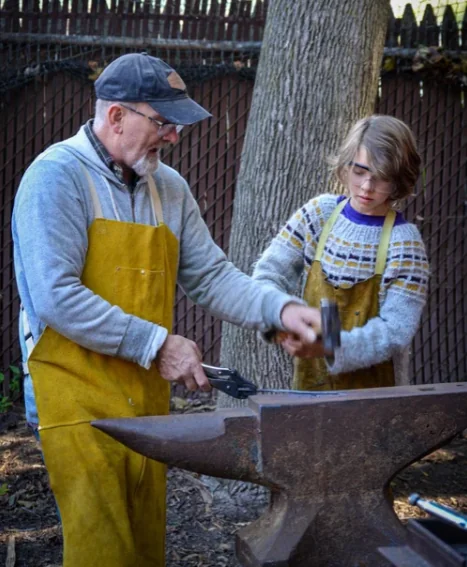
In recent years, students have used their projects to study the practice and history of comedy; to repurpose materials, using the leg of a table to make a lamp or an old piano top to make an elegant table; and to learn to weld, using that skill to make thoughtful and whimsical sculptures.

Students in all middle grades learn history by reading and discussing biographies rather than simply memorizing facts and dates, creating a larger context for their understanding of the world and the past.

While studying botany in fifth grade, students read about George Washington Carver, who fought for his own education, and went on to teach a nation to heal the land using crop rotation, especially the peanut plant, after years of depletion by the cotton plant.

When learning about the rise and fall of Roman civilization, sixth-graders read about Zhang Qian, who mapped out the nomadic pathways through the mountains that led to great markets, especially the well-traveled Silk Road.

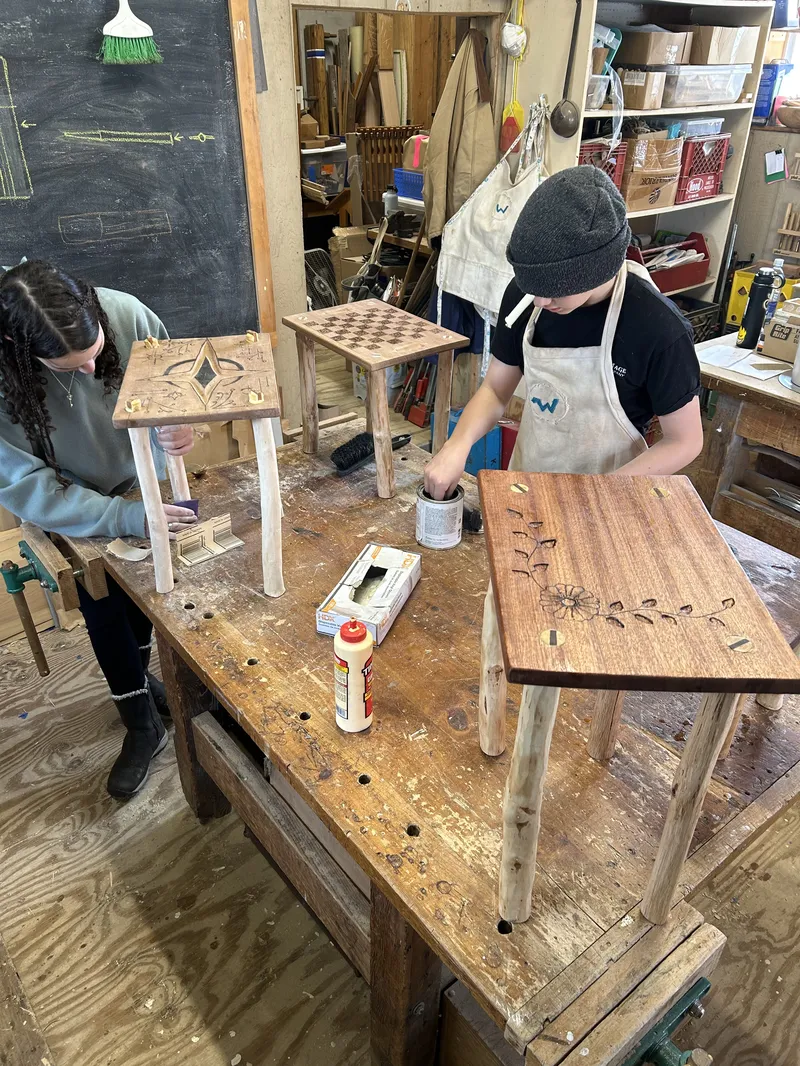
Middle school students in the woodshop hand-carving and finishing wooden stools with decorative floral and geometric details at traditional workbenches

The Arts Remain Central

Students discover history through class plays. Illustrated Main Lesson books allow them to artistically express and digest what is learned in class. Woodworking builds deep focus, geometry skills, and complex problem-solving skills. These are just a few examples of how arts remain central and complement deep learning.

What Makes Our Middle School Different

1

The Arts Remain Central

Students create illustrated Main Lesson books, perform annual plays including Shakespeare, and participate in both chorus and instrumental ensemble.

  • Art isn't an extra - it's how learning comes alive for adolescents.

Learning feels meaningful and connected to the world around them.

2

Small Classes, Deep Relationships

With 11-15 students per class and teachers who know them over multiple years, every middle schooler is seen as an individual.

  • When something's off, we notice.

Your child is seen, supported, and guided - not managed or standardized.

3

A Phone-Free Environment

No smartphones during school. Students learn focus, have real conversations, and navigate social dynamics face-to-face.

  • Skills that will serve them throughout life.

Your child develops focus, resilience, and confidence.

4

Meaningful Experiences

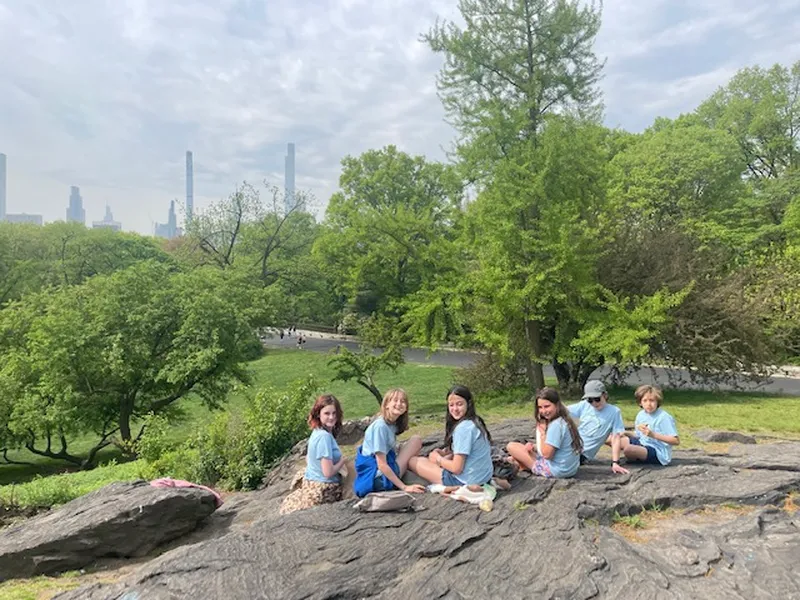
Our signature trips bring curriculum alive: Medieval Games in 6th grade, a Quebec City French scavenger hunt in 7th grade, and a student-planned culminating trip in 8th grade.

  • Learning is experienced, not just observed.

Students carry these experiences with them for life.

Six middle school students in matching light blue shirts sitting together on a rock outcrop in Central Park with the New York City skyline visible through the trees behind them

Signature Trips

A highlight of our lower and middle school language program is an immersive cultural trip to Montreal and Quebec City for a week, including an extensive scavenger hunt -- exclusively in French -- in small self-led groups among landmarks and experiences in Old Quebec. Each eighth grade class marks their eight years together with a class trip. Past trips have ranged from paddling the Battenkill to touring Boston.

Students working together in small groups on a collaborative project

A Phone-Free Sanctuary

No smartphones during school. Students learn to focus deeply, have real conversations, and navigate social dynamics face-to-face. In an era of digital distraction, we protect genuine connection.

The middle school years can be challenging, but Waldorf gave our son exactly what he needed - intellectual challenge, creative outlet, and teachers who really knew him. He graduated confident and genuinely excited about learning.

Karen R., parent of 2024 graduate

Ready to Learn More?

The best way to understand what makes Waldorf Middle School distinctive is to visit our campus, observe a classroom, and talk with teachers and current families.

Contact Admissions
Email: admissions@waldorfsaratoga.org
Phone: (518) 587-0549

Explore Our Programs

Waldorf Middle School is located at our Lower School campus. Students in grades 6-8 learn alongside Early Grades students, maintaining connections with younger children while preparing for high school transition.

Ages 18 months - 6 years

Early Childhood

Where the foundation begins. Play-based learning, nature immersion, and the warmth of consistent caregivers prepare children for the journey ahead.

Learn More
Grades 1-5

Early Grades

Where learning comes alive. Teacher looping, arts-integrated curriculum, and hands-on experiences build deep understanding and love of learning.

Learn More
Contact Admissions