
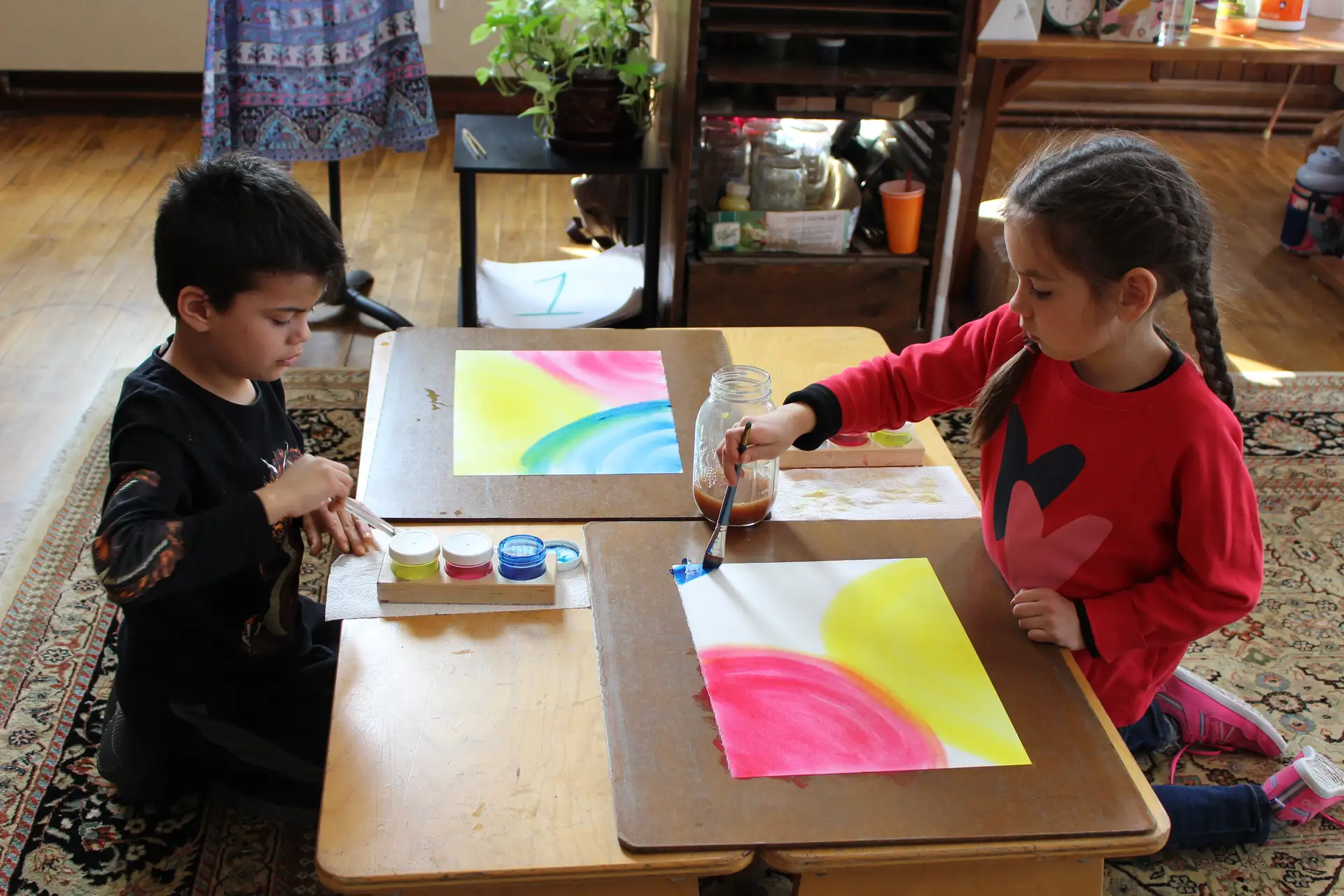
If you’ve heard people talk about Waldorf education but aren’t quite sure what it actually means, this short post is for you!
Waldorf education has been around for more than a century and is practiced in more than 1,000 schools around the world. It combines strong academics with movement, the arts, practical work and deep relationships, all guided by one simple idea: children learn best when education matches how they naturally develop.
You’ll often hear the phrase “whole child education.” That isn’t educational jargon. It simply means we don’t think children are just minds that need information. We care about how they think, how they feel and what they can do with their own hands. Around Waldorf, you’ll often hear this described as educating the head, heart and hands.
But what about academics?
It’s a fair question.
From the outside, Waldorf classrooms can look very different from what many parents experienced in school. There is more movement, more storytelling, more art and more hands-on work.
What you don’t always see at first glance is that those experiences are carefully designed to support serious academic learning.
Students study mathematics, science, literature, history and writing throughout the grades. They write extensively, solve increasingly complex mathematical problems, conduct laboratory science, read classic literature and develop strong communication skills. The goal isn’t to do less academics—it’s to help children understand ideas deeply instead of simply memorizing them.
Why do Waldorf students learn differently?
Waldorf education asks a different question than many schools.
Instead of asking, “How early can we teach this?” we ask, “When is a child developmentally ready to learn it well?”
That philosophy influences everything from reading instruction to mathematics.
Young children spend more time building language through stories, conversation, music and play before formal reading instruction begins. As they grow, reading, writing and mathematics become daily academic work, taught in ways that engage imagination, movement and real-world application rather than worksheets alone.
This doesn’t mean children learn less.
It means they often learn more deeply because ideas are connected to experience rather than simply memorized for a test.
Learning by doing
At Waldorf, lessons are designed to become experiences.
Fractions might be explored through baking. Geometry appears through woodworking. History comes alive through storytelling, drama and art. Science is observed, experimented with and discussed before conclusions are memorized.
When children actively engage with what they’re learning, ideas tend to stay with them. Movement is part of learning, not a break from it.
Throughout the grades, students play games, move, practice coordination, sing, perform and participate in activities that support healthy physical and cognitive development. These experiences aren’t separate from academics—they help children focus, collaborate and think clearly.
The arts aren’t electives, either.
Music, painting, handwork, woodworking and performance are woven throughout the curriculum because creativity strengthens observation, perseverance, problem-solving and confidence. These are abilities that support every academic subject, not distractions from them.
Do Waldorf graduates succeed?
Parents naturally wonder whether this different approach prepares students for what’s next.
The answer is yes.
Waldorf graduates attend outstanding public and private high schools and go on to colleges and universities across the country. They pursue careers in medicine, engineering, business, education, the arts, entrepreneurship and countless other fields.
Just as importantly, many alumni describe leaving Waldorf with something that is harder to measure but equally valuable: curiosity, resilience, creativity, confidence and the ability to think independently. Those qualities serve them long after graduation.
A different path to the same goal
Perhaps that’s the biggest misconception about Waldorf education.
It isn’t a choice between academics or creativity.
It’s the belief that children learn academics best when curiosity, movement, the arts and meaningful relationships are part of the learning process.
The goal isn’t simply to help children score well on the next test. It’s to help them become capable learners, thoughtful human beings and confident young adults who are prepared not just for high school or college—but for a lifetime of learning.
That’s Waldorf in a nutshell.